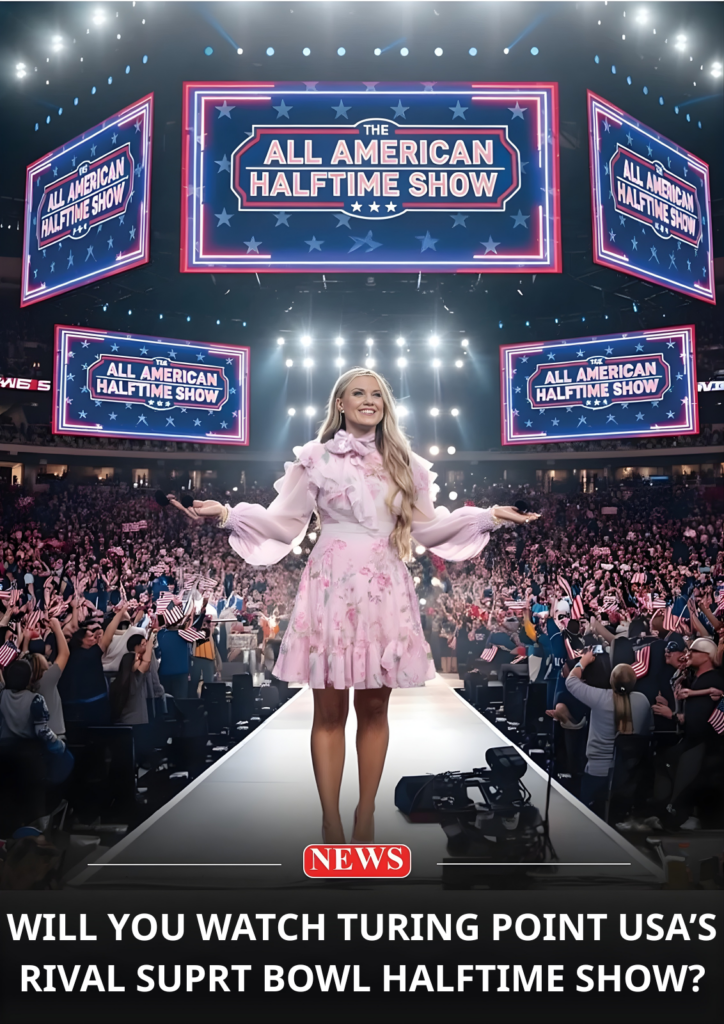
The announcement of The All-American Halftime Show—scheduled to air at the exact same time as Super Bowl LX—has ignited one of the most explosive cultural debates of 2026.
More than a music program, the event spearheaded by Erika Kirk is being viewed as a test of power, a collision point where faith, politics, and American identity converge on a single national stage.
In recent days, a flurry of rumors surrounding the project has circulated with more force than any official marketing campaign.
From a mysterious “$100 million war chest” to Starlink livestream workarounds and AI holograms honoring Charlie Kirk, each leak has added fresh fuel to an already volatile cultural climate.
A divided America, facing off at halftime

Media analysts say this may be the first time in history that the Super Bowl halftime show—long considered the “sacred commercial temple” of the entertainment industry—is challenged head-to-head by a privately organized, ideologically charged alternative.
- On one side: the NFL—an entertainment titan with unmatched commercial power.
- On the other: Erika Kirk’s “cultural counteroffensive,” appealing to religious audiences, conservative communities, and those who believe America has lost its spiritual center.
The clash is so stark that some observers have labeled it “America’s cultural cold war—played out at halftime.”
Grief turned into a movement?
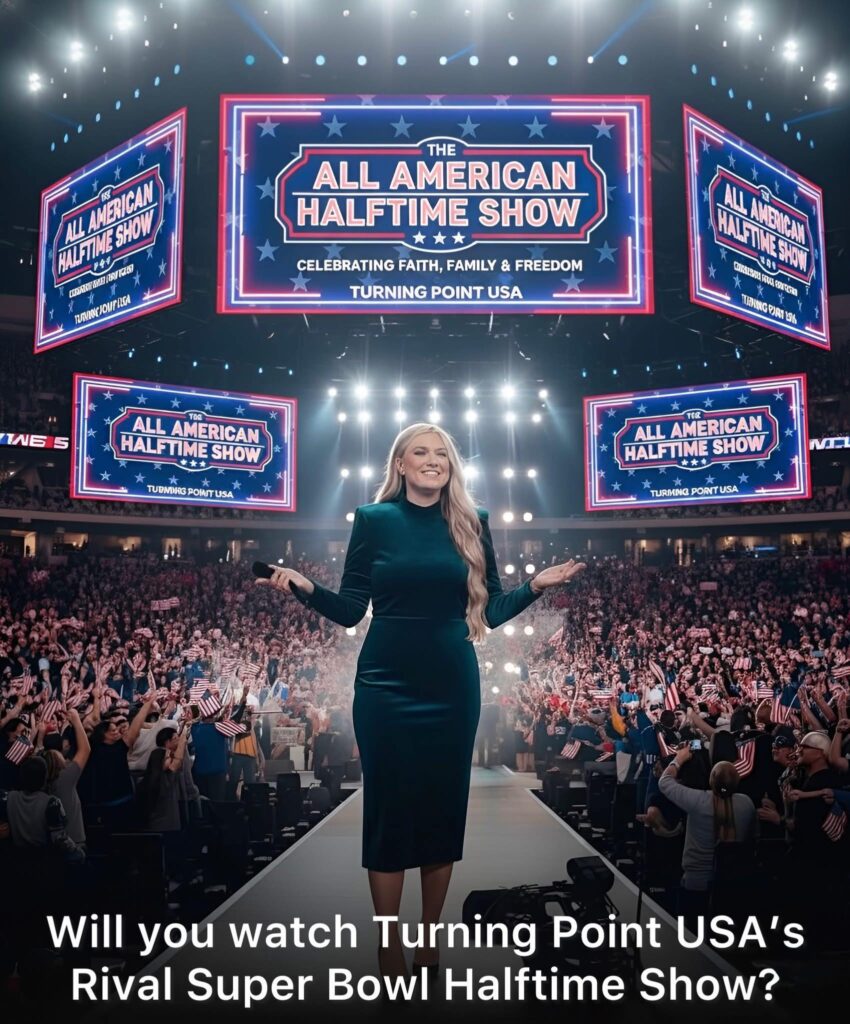
The invocation of Charlie—a name Erika calls the heart of the mission—adds a deeply emotional layer to the story.
Sociologists note that the public’s debate over whether this is “grief-driven madness or the birth of a new national ritual” reflects a deeper truth: American culture is searching for meaning in an era defined by division.
If the show succeeds, it could:
- redefine broadcasting outside traditional corporate structures,
- allow social groups to build their own cultural “ritual spaces,”
- and potentially weaken the NFL’s long-held cultural monopoly.
Why is the entertainment world panicking?
Several Hollywood executives, speaking anonymously, admit that the show represents a threat to the structure of modern entertainment:
- A break from traditional content gatekeeping
A livestream with no corporate sponsors and no network oversight. - The rise of parallel programming
If an independent show captures even a fraction of the Super Bowl audience, power centers could shift dramatically. - A future where entertainment is driven by beliefs, not just spectacle
Audiences are no longer seeking only emotion—they’re seeking meaning, identity, and belonging.
Super Bowl 2026: The most important battle won’t be on the field
On February 8, 2026, Americans won’t just be watching a championship game.
They will be watching:
- Who controls the national narrative?
- Who captures the emotional core of the country?
- And is this the beginning of a cultural era in which traditional secular “national rituals”—like the Super Bowl—are challenged by new spiritually infused alternatives?
Whatever happens, one thing is clear: